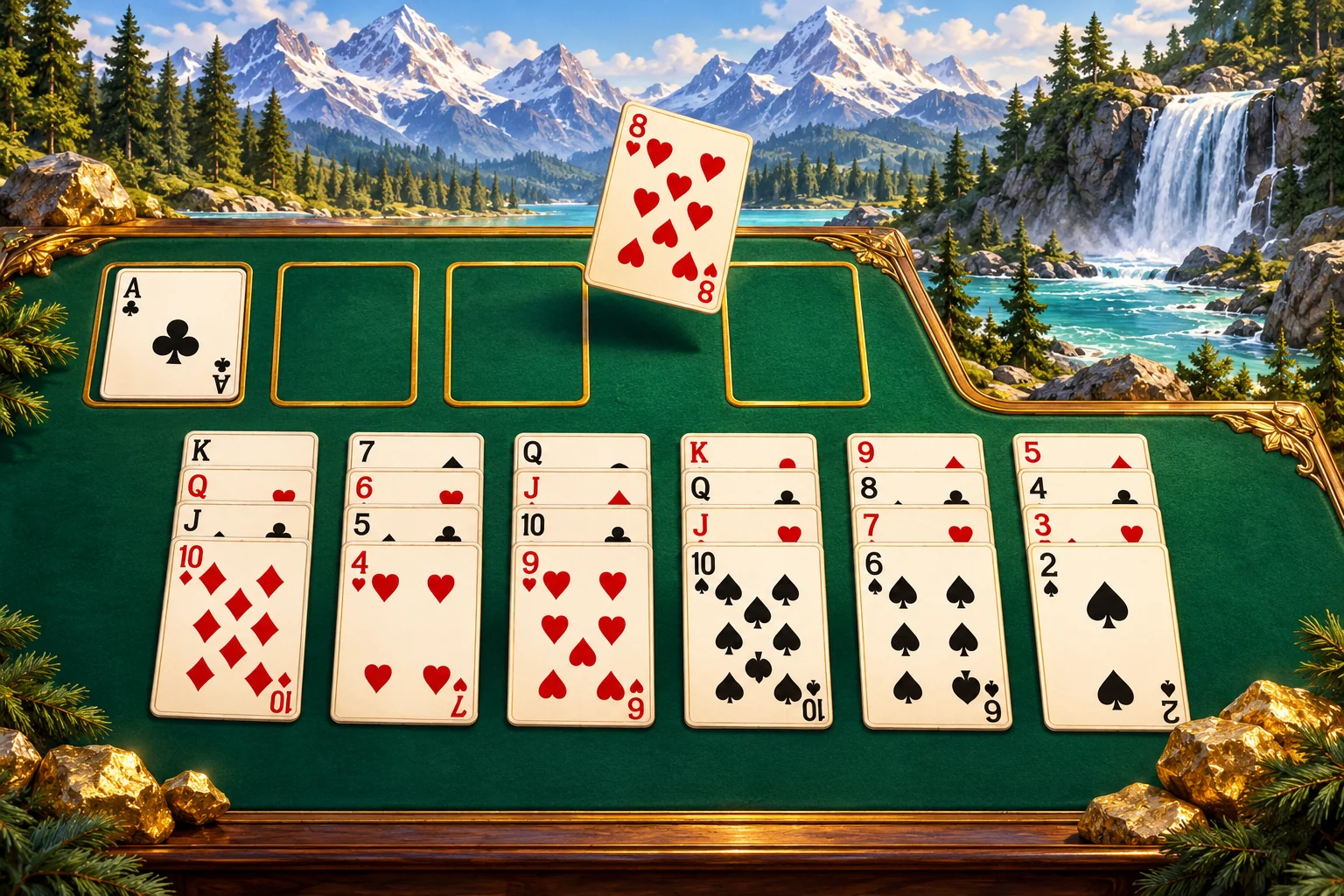
Deal: 52 cards, all face upSpace: Four cells and eight columnsFoundations: Build upward by suit
Understand the three kinds of space
The tableau contains eight columns, with all 52 cards dealt face up. The four free cells each hold one card. The four foundations are the final homes for the suits, beginning with Aces. There is no stock pile, so drawing cannot reveal a new option; progress comes from reorganizing the cards already on the board.
Tableau cards stack downward in alternating colors. A red five can go on a black six, for example. An empty column can accept any card or legal run, while a free cell can hold just one card. Foundations rise within a single suit: Ace, two, three, and so on.
Use cells to reach a specific card
Look for a buried Ace or a low card that can follow an existing foundation. Identify the cards above it, then consider where each could go. A free cell can temporarily hold a blocker, but it is most useful when you already see how to release it. Filling every cell without a plan can leave you with very few ways to rearrange the tableau.
- Choose a useful card to uncover, such as a reachable Ace.
- Find legal column destinations before using a free cell.
- Move one blocker into a cell only when you need that extra space.
- Return the parked card to a column or foundation when the route opens.
Understand why some runs cannot move
A descending alternating-color sequence needs enough spare cells and empty columns to support its move. In this app, available cells increase the number of cards you can move, and spare empty columns extend that capacity. The destination does not count as spare storage for the same move. A correctly ordered run can therefore be too long to transfer in the current position.
If that happens, free a cell or another column, or move a shorter part of the sequence. Klondike Gold 24K offers hints, Undo, and a solvable warm-up in its coming-soon iPhone and iPad app. Finish is available only after a legal completion route is verified. Full shuffled deals are not guaranteed solvable.
Common questions
Can I move a King into a free cell?
Yes. A free cell can hold any one card, including a King. Consider how you will move it out again, because an occupied cell reduces working room.
Can any card fill an empty column?
Yes. FreeCell allows any card or a legal sequence to enter an empty column. This differs from Klondike, which requires a King at the head.
Does the game hide any cards?
No. All 52 cards are visible. The challenge is access and arrangement, rather than discovering cards from a hidden stock.